Private AI vs. Public AI: What’s the Difference for Businesses?
August 24, 2026 · Tatyana Vadich

Private AI vs. Public AI: What Businesses Need to Know
Private AI and public AI can both help businesses generate content, analyze documents, write code, summarize information, and support everyday decision-making. The main difference is how AI systems are accessed, where data is handled, and how much control an organization has over its use.
Public AI typically refers to AI services available through consumer-facing platforms, while private AI generally refers to AI environments designed to give an organization greater control over its data, access, infrastructure, and governance. However, the distinction is not always as simple as “private versus public.” Businesses can also use enterprise AI platforms that provide controlled access to public AI models without deploying or operating their own models.
For organizations adopting generative AI, understanding these differences is important because the right approach depends on the type of data being processed, security requirements, business workflows, and the level of control the organization needs.
What Is Public AI?
Public AI refers to AI services that are broadly available to individuals and organizations through public or consumer-facing platforms.
Examples include general-purpose AI assistants and publicly accessible generative AI services that allow users to enter prompts and receive generated text, images, code, or other content.
Public AI is attractive to businesses because it is easy to access. Employees can typically create an account, open a browser, and start using an AI model without requiring an internal AI infrastructure project.
For many low-risk tasks, this convenience can be useful.
Common business uses include:
- Brainstorming ideas
- Drafting marketing content
- Summarizing publicly available information
- Generating first drafts of documents
- Translating text
- Creating code examples
- Research assistance
- Creating meeting summaries
The challenge begins when employees start using public AI tools with confidential, proprietary, personal, or regulated information.
NIST identifies data privacy, information security, intellectual property, and other risks among the concerns organizations should consider when adopting generative AI.
What Is Private AI?
Private AI generally describes an AI environment where an organization has greater control over the infrastructure, data, access, and operating policies surrounding AI.
Depending on the architecture, private AI can mean:
- AI models deployed inside an organization's own environment
- Models hosted in a dedicated private cloud
- AI systems operating within controlled infrastructure
- Private access layers placed between employees and AI model providers
- Enterprise AI platforms with centralized governance and controlled data handling
This is where terminology can become confusing.
Private AI does not necessarily mean that an organization has built its own AI model.
A company can use an existing large language model while still creating a more controlled enterprise environment around how employees access that model and how business data is handled.
That distinction matters because building and operating a foundation model is very different from implementing a secure enterprise AI environment.
Private AI vs. Public AI: The Key Differences
The most important difference is control.
| Area | Public AI | Private / Controlled AI |
|---|---|---|
| Access | Usually individual or broadly available | Controlled by the organization |
| Data handling | Depends on the provider and configuration | Organization can apply defined policies |
| Governance | Often limited at the organizational level | Centralized policies and controls are possible |
| Infrastructure | Provider-managed public service | Private, dedicated, or controlled environment |
| Model choice | Depends on the service | Can support one or multiple models |
| Employee visibility | Can be fragmented | Centralized usage can improve visibility |
| Deployment | Usually quick | May require more planning |
| Customization | Depends on provider | Potentially greater control |
| Cost | Often subscription or usage based | Can include infrastructure and management costs |
The exact architecture varies between providers. “Private AI” is therefore better understood as a spectrum of control rather than a single technical configuration.
Is Private AI More Secure Than Public AI?
Not automatically.
A private AI environment can provide stronger control over data, access, and infrastructure, but simply calling a system “private” does not make it secure.
Security depends on how the AI environment is designed and operated.
Organizations should consider:
- Where prompts and uploaded files are processed
- Whether prompts and responses are stored
- Whether data can be used for model training
- How users authenticate
- Who can access AI conversations
- How data is transmitted
- Where data is stored
- How vendors handle third-party model access
- How activity is monitored
- What happens when an employee leaves the organization
- How AI-related incidents are detected and handled
NIST's AI Risk Management Framework emphasizes managing AI risks according to an organization's goals, risk tolerance, and operating environment rather than relying on a single technical control.
In other words, private does not automatically mean secure, and public does not automatically mean unsafe.
The important question is how much control the organization has and whether that control matches its risk requirements.
Why Public AI Can Become a Business Risk
The biggest issue with public AI is often not the technology itself. It is uncontrolled use.
An employee may paste information into an AI assistant because it is the fastest way to solve a problem.
That information might include:
- Customer information
- Internal financial data
- Contracts
- Product specifications
- Source code
- Employee information
- Business strategies
- Confidential reports
- Proprietary processes
The employee may not know exactly how the service handles that information or what organizational policies apply.
This is one reason Shadow AI has become a concern for organizations. When employees independently adopt AI tools without centralized oversight, companies can end up with multiple AI subscriptions, inconsistent policies, and limited visibility into how AI is being used.
The issue is not necessarily that employees should not use AI.
The issue is how organizations can give employees useful AI tools without losing control of business information.
When Does Private or Controlled AI Make Sense?
Private or controlled AI becomes particularly relevant when employees need to work with sensitive or proprietary information.
Typical examples include:
Legal and Professional Services
Law firms and professional service organizations may use AI to summarize documents, prepare drafts, organize research, or analyze large volumes of information.
Because client information can be sensitive, organizations may require stronger controls over AI usage.
Financial Services
Financial organizations may use AI for document analysis, reporting, research, and internal workflows.
These use cases can involve financial, customer, or business-sensitive information, making data handling and governance important considerations.
Healthcare
Healthcare organizations may explore AI for administrative processes, document workflows, research, and other applications.
Depending on the use case and jurisdiction, organizations may have additional privacy and regulatory requirements.
Software Development
Development teams increasingly use AI for code generation, debugging, documentation, and technical research.
For companies with proprietary source code or intellectual property, controlling how code and internal documentation are shared with AI services can be important.
Manufacturing and Operations
Manufacturers may use AI to analyze documentation, procedures, technical specifications, maintenance information, and operational data.
In these environments, the ability to control access to internal information can be just as important as the AI model itself.
Do Businesses Need Their Own Private AI Model?
No.
This is one of the most important distinctions for businesses evaluating AI.
A company does not necessarily need to build, train, or host its own large language model to create a more controlled AI environment.
There are several possible approaches:
- Public AI tools — employees use consumer-facing AI services directly.
- Enterprise versions of AI services — organizations use business-oriented versions offered by model providers.
- Private model deployment — an organization deploys a model in its own infrastructure or dedicated environment.
- Enterprise AI platforms — an organization uses a controlled platform that provides access to multiple AI models and applies centralized policies around AI usage.
The right choice depends on the organization's technical requirements, budget, data sensitivity, model requirements, and governance needs.
Private AI vs. Enterprise AI Platforms
Private AI and enterprise AI platforms are related, but they are not necessarily the same thing.
A private AI deployment may focus primarily on where the model and infrastructure run.
An enterprise AI platform may focus more broadly on how employees access and use AI across the organization.
For example, an enterprise platform like AskElixir.ai may provide:
- Centralized access to multiple AI models
- Controlled authentication
- API-based model access
- Data-handling policies
- Centralized administration
- Structured outputs
- File processing
- Usage management
- A consistent interface for employees
This approach can be useful for organizations that do not want to choose a single AI model for every business task.
Different models may perform differently depending on the use case. A company may want one model for reasoning, another for content generation, and another for a specific technical workflow.
Instead of asking employees to manage several disconnected AI accounts, an organization can provide access through a centralized environment.
Where Does AskElixir.ai Fit?
AskElixir.ai is an example of an enterprise AI platform rather than a privately trained AI model.
The platform provides access to multiple AI models through a single, privacy-focused workspace. Its architecture uses API-only model access rather than consumer AI interfaces, and the platform states that prompts and responses are not stored or used for training by default.
This distinction is important.
AskElixir.ai does not require an organization to build its own foundation model simply to provide employees with more controlled access to AI.
Instead, it provides a centralized layer for working with multiple models.
For businesses evaluating AI, this can address a different problem from private model hosting.
The question becomes:
How can we give employees access to powerful AI models while maintaining greater organizational control over how AI is accessed and used?
For organizations asking that question, a centralized enterprise AI platform can be an alternative to managing multiple consumer AI subscriptions independently.
What Should Businesses Consider Before Choosing an AI Approach?
There is no single AI architecture that works for every organization.
Before choosing between public AI, enterprise AI services, private deployments, or a centralized AI platform, consider the following.
1. What Type of Data Will Employees Use?
Start with the data, not the AI model.
Separate use cases involving:
- Public information
- Internal business information
- Confidential information
- Personal information
- Regulated information
- Intellectual property
The more sensitive the information, the more important data-handling controls become.
2. How Much Control Is Required?
Ask who should control:
- User access
- Model access
- Data handling
- Account management
- Usage policies
- AI-related workflows
A small company using AI for public marketing research may not need the same controls as a financial institution processing sensitive information.
3. Do Employees Need Multiple Models?
If different teams use different AI models, managing individual subscriptions can become complicated.
A centralized platform may make more sense when an organization wants access to multiple models without creating a separate AI environment for every team.
4. Where Does the Data Go?
This question should be specific.
Do not stop at asking whether an AI platform is “secure.”
Ask:
- Is data stored?
- For how long?
- Is it used for training?
- Who can access it?
- Is it transmitted to third-party model providers?
- Where is it processed?
- What controls exist around uploaded files?
These questions provide much more useful information than a generic security label.
5. What Are the Total Costs?
AI costs can include much more than the model subscription.
Consider:
- User subscriptions
- API usage
- Infrastructure
- Administration
- Integration
- Security controls
- Monitoring
- Employee training
- Vendor management
A solution that appears inexpensive at the individual-user level may become more complicated when deployed across an organization.
A Practical Decision Framework
A simple way to evaluate the options is to start with the level of control your organization needs.
Public AI may be appropriate when:
- The information is low-risk.
- Employees are working primarily with public information.
- The organization has limited governance requirements.
- Speed and convenience are the main priorities.
Enterprise AI services may be appropriate when:
- The organization needs business-oriented controls.
- Employees use AI regularly.
- Centralized administration is important.
- The organization wants to work with a specific model provider.
Private AI deployment may be appropriate when:
- The organization requires significant infrastructure control.
- Data residency or isolation requirements are particularly strict.
- The organization has the technical resources to operate the environment.
- A specific model needs to run in a dedicated environment.
A centralized enterprise AI platform may be appropriate when:
- Employees need access to multiple AI models.
- The organization wants to reduce fragmented AI usage.
- Centralized access and governance are important.
- The company wants stronger control without building its own AI infrastructure.
These categories can overlap. An organization may also use different approaches for different AI workloads.
Private AI vs. Public AI: Frequently Asked Questions
What is the difference between private AI and public AI?
Private AI generally provides an organization with greater control over AI infrastructure, access, and data handling. Public AI services are broadly available and typically managed by an external provider. The exact level of privacy and control depends on the specific architecture and provider.
Does private AI mean the AI model is hosted internally?
Not always. Private AI can refer to different architectures, including internally hosted models, dedicated environments, private cloud deployments, or controlled enterprise platforms surrounding externally provided models.
Do businesses need their own AI model?
No. Most businesses do not need to train their own foundation model. Organizations can use existing AI models through enterprise services, APIs, private deployments, or centralized AI platforms depending on their requirements.
Can businesses use public AI with confidential information?
Whether confidential information can be used depends on the specific service, configuration, organizational policies, contractual requirements, and applicable privacy or regulatory obligations. Businesses should understand exactly how prompts, files, and responses are handled before entering sensitive information into an AI service.
What is an enterprise AI platform?
An enterprise AI platform provides organizations with a centralized environment for using AI across business teams. Depending on the platform, it may provide access to multiple models, centralized administration, controlled data handling, usage management, and other enterprise-oriented capabilities.
What should businesses look for in a private or enterprise AI platform?
Businesses should evaluate data handling, model access, authentication, administration, privacy policies, integration options, auditability, vendor practices, pricing, and the ability to support their specific AI use cases.
The Bottom Line
The choice between private AI and public AI is not simply a choice between “secure” and “insecure.”
The more useful question is:
How much control does your organization need over AI, and what architecture provides that control without creating unnecessary complexity?
Public AI can be practical for low-risk tasks and experimentation. Private AI deployments can provide extensive infrastructure and data control, but they can also require significant technical resources.
For many organizations, the middle ground is an enterprise AI platform that provides controlled access to multiple models without requiring the company to build and operate its own AI infrastructure.
That approach can help organizations move from individual AI experimentation toward a more structured model of enterprise AI adoption.
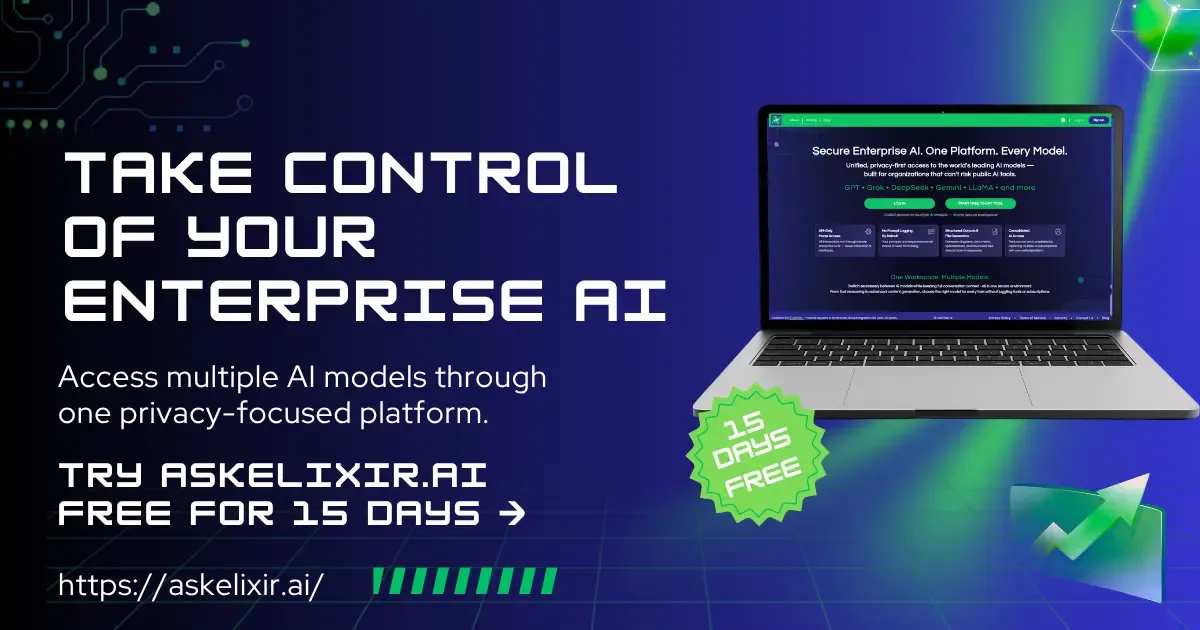
AskElixir.ai is designed for organizations looking for that kind of centralized approach, providing access to multiple AI models through one enterprise-focused workspace, with API-only model access and privacy-focused data handling.
If your organization is evaluating how to give employees access to multiple AI models while maintaining greater control over AI usage, AskElixir.ai offers a 15-day free trial to explore the platform and its capabilities.